
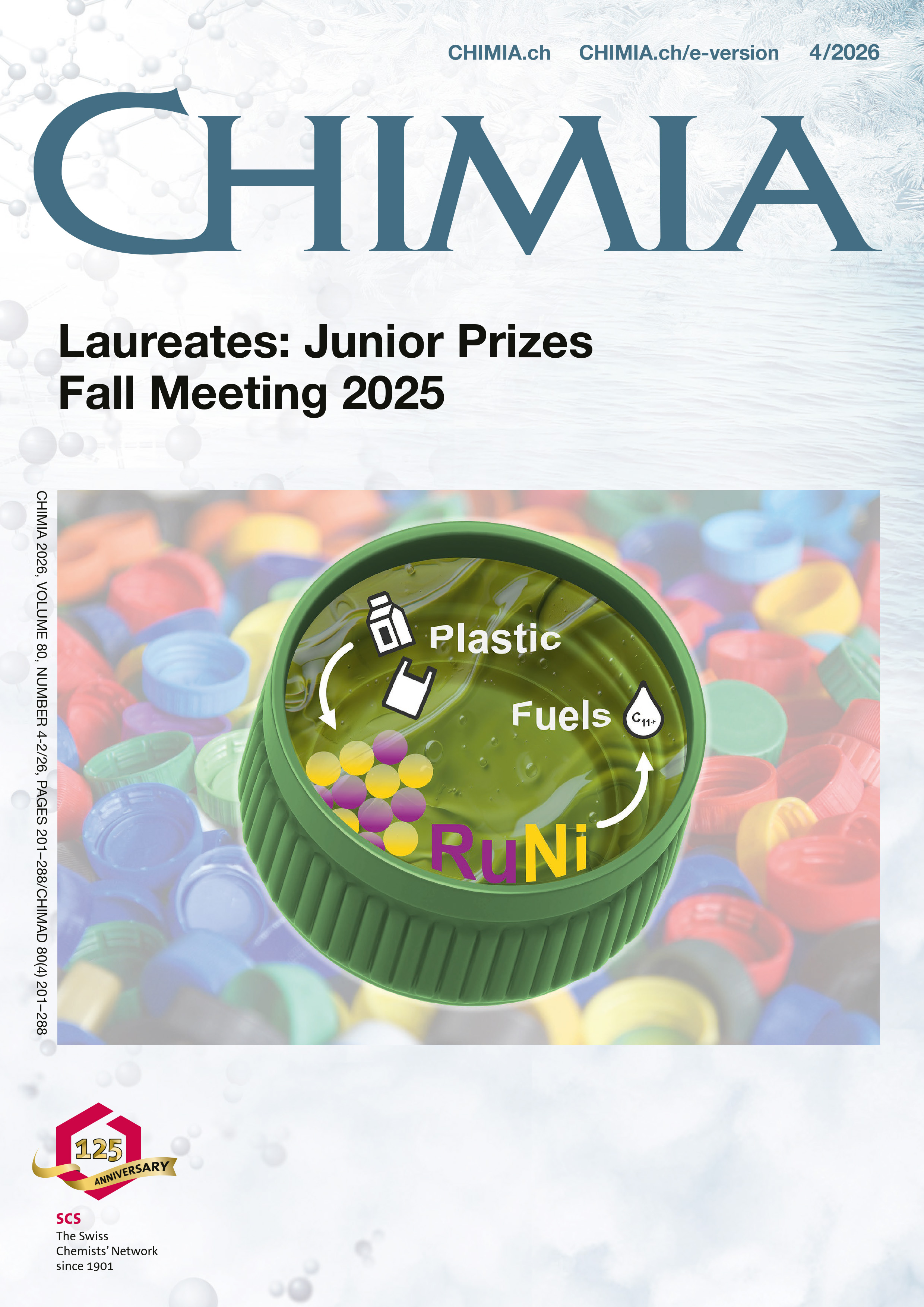
Bridging Catalyst Design and Process-Level Analysis for Sustainable Polyethylene Recycling via Hydrogenolysis
DOI:
https://doi.org/10.2533/chimia.2026.245PMID:
42104894Keywords:
Heterogeneous catalysis, Life cycle assessment, Plastic recycling, Polyolefin hydrogenolysis, Techno-economic analysisAbstract
Aligning catalyst development with process-level sustainability metrics is crucial for advancing the chemical recycling of plastics. We bridge both elements to study hydrogenolysis of high-density polyethylene and report Ru–Ni alloy nanoparticles supported on titania that yield up to 55% liquid alkane products (C6–C45) under optimized conditions. Operando spectroscopy reveals Ru–Ni alloy sites formed in situ, and temperature-programmed experiments suggest an enhanced preference for internal instead of terminal scission over the bimetallic catalysts. By integrating these experimental insights with life cycle and techno-economic analyses, we identify a minimum average-chain-length threshold of C11 for product distributions as a catalyst design guideline to reconcile environmental and economic objectives, illustrating the value of bridging catalyst design and process-level analyses.
Funding data
-
NCCR Catalysis
Grant numbers 225147
Downloads
Published
Issue
Section
License
Copyright (c) 2026 Iris Nogueroles-Langa, Yuzhen Ge, Cecilia Salah, Gonzalo Guillén-Gosálbez, Antonio J. Martín, Javier Pérez-Ramírez

This work is licensed under a Creative Commons Attribution 4.0 International License.