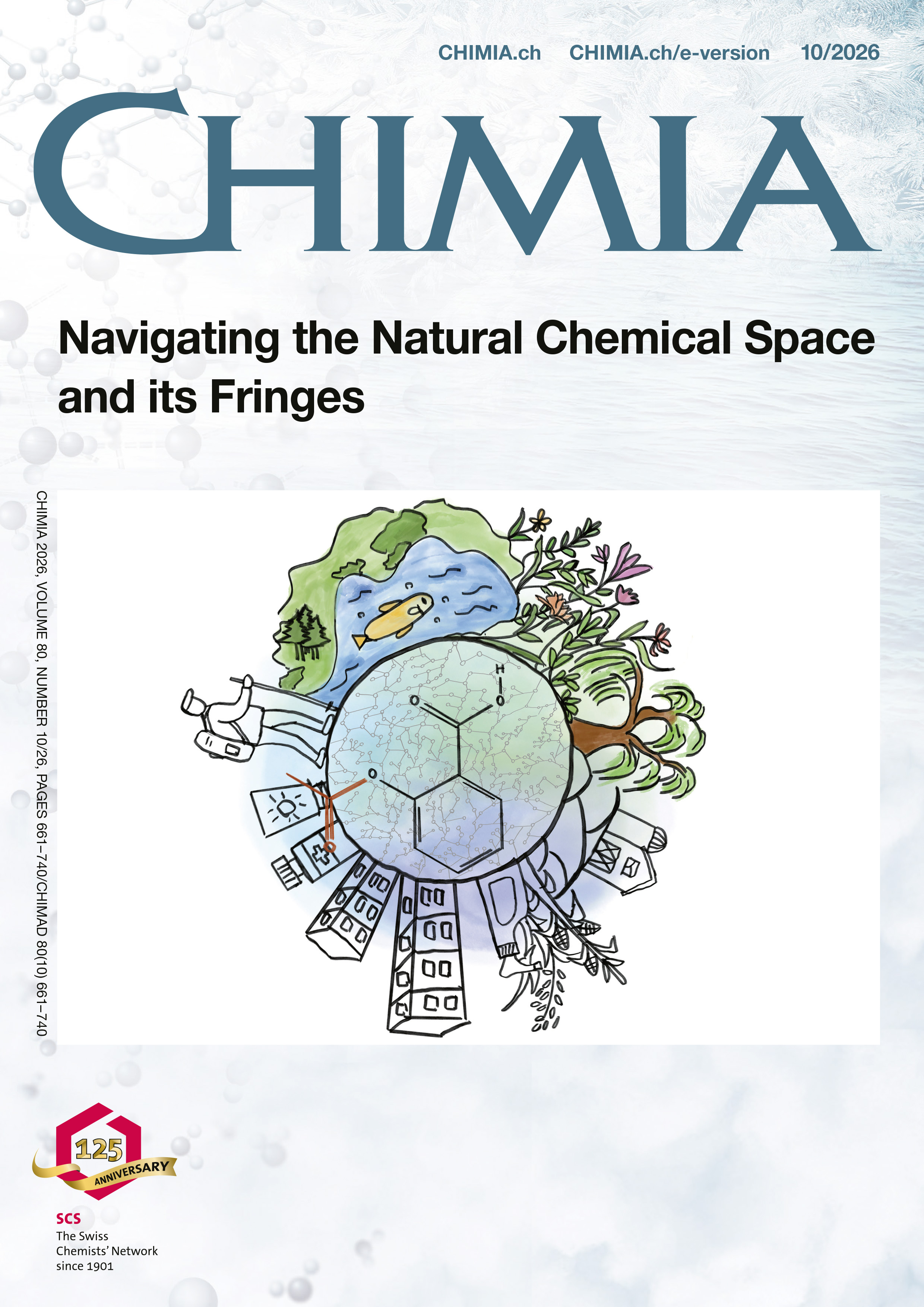
From LC-MS Metabolomic Profiling to AIEnabled Navigation of NPs Chemical Space: Recent Advances and Emerging Directions
DOI:
https://doi.org/10.2533/chimia.2026.676Keywords:
Artificial intelligence, Biotransformation, Knowledge graphs, Metabolomics, Natural productsAbstract
Natural products (NPs) occupy a unique region of chemical space and continue to provide privileged scaffolds for drug discovery, chemical ecology, and biotechnology. However, the exploration of NP diversity remains constrained by the complexity of biological extracts, the low annotation rate of LC-MS features, and the rediscovery of known metabolites. Recent advances in LC-HRMS/MS-based metabolomics, coupled with expanding spectral and structural databases, molecular networking, and in silico annotation methods, have considerably improved the characterization of complex metabolomes and facilitated large-scale exploration of natural chemical space. Simultaneously, artificial intelligence (AI) and machine-learning approaches are enhancing metabolite annotation, chemical classification, and prioritization, while knowledge graph technologies enable the integration of chemical, taxonomic, biological, and ecological information into interoperable, AI-ready frameworks. This mini-review highlights recent developments that support a transition from conventional metabolite annotation towards effective navigation of NP chemical space. We discuss the role of open data resources, computational metabolomics, knowledge-driven data integration, and emerging AI-assisted tools in accelerating NP discovery. We also examine how biotransformation and chemoenzymatic diversification can extend the boundaries of natural chemical space by generating nature-inspired molecules and previously inaccessible scaffolds. Together, these approaches are paving the way towards a more predictive, integrative, and data-driven paradigm for NP research and bioactive compound discovery.
Funding data
-
Schweizerischer Nationalfonds zur Förderung der Wissenschaftlichen Forschung
Grant numbers IC00I0L-231646 -
Schweizerischer Nationalfonds zur Förderung der Wissenschaftlichen Forschung
Grant numbers 205320_215078
Downloads
Published
Issue
Section
License
Copyright (c) 2026 Jean-Luc Wolfender; Loïc Le Grégam, Emerson Ferreira Queiroz

This work is licensed under a Creative Commons Attribution 4.0 International License.