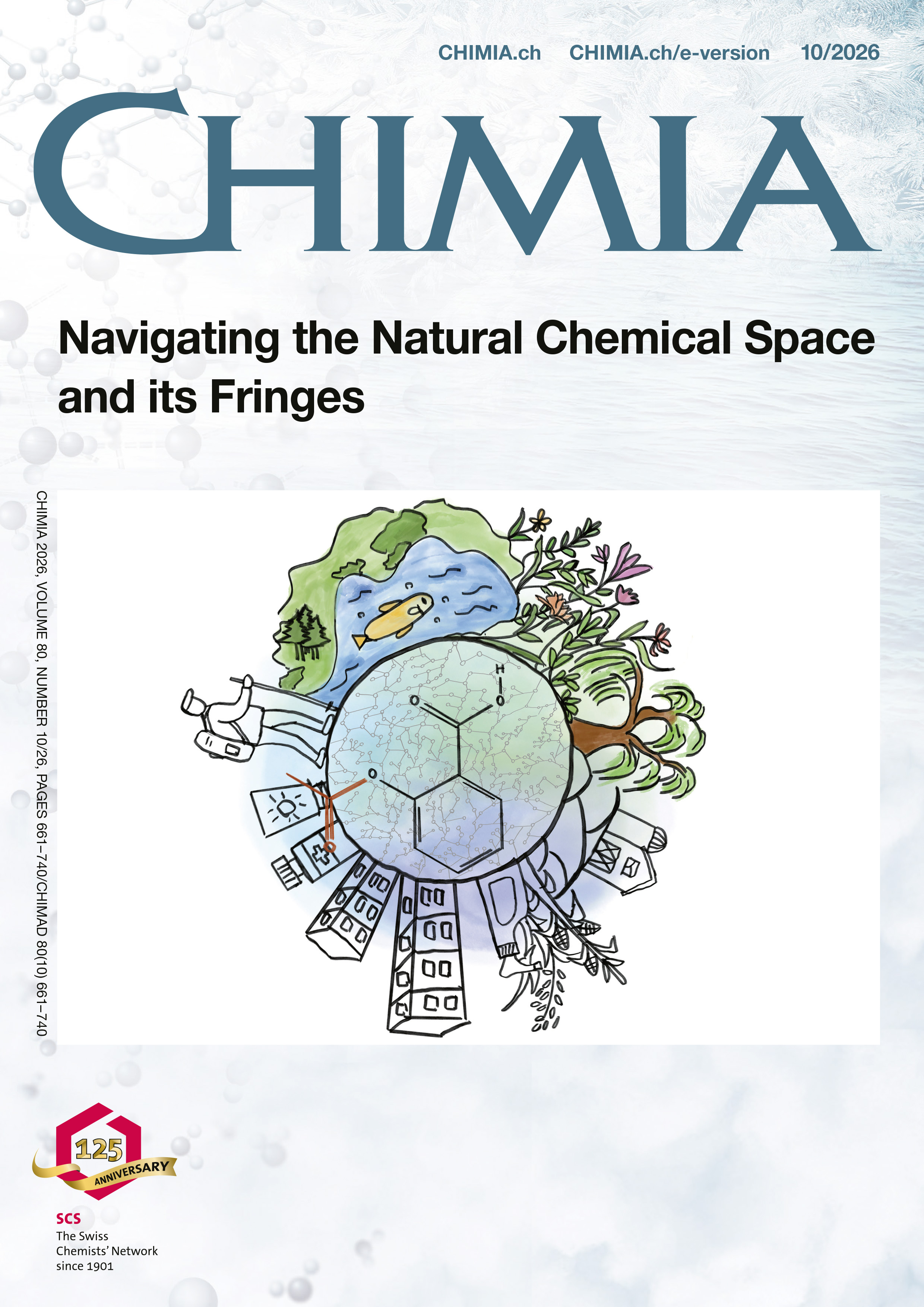
Drivers of Phytochemical Diversity Along Elevation Gradients
DOI:
https://doi.org/10.2533/chimia.2026.709Keywords:
Chemodiversity, Climate change, Ecological drivers, Elevation gradients, Plant-insect interactionsAbstract
Mountains compress steep environmental gradients into short distances, making elevation an ideal natural laboratory for investigating the ecological drivers of phytochemical diversity. While elevational patterns in species richness have been studied extensively, the factors governing phytochemical diversity along mountain slopes remains poorly understood. Through a systematic literature search, we synthesise evidence to evaluate the patterns, drivers and hypotheses of phytochemical diversity across elevation gradients. Reported patterns are mixed, nonlinear, and strongly context-dependent, varying among plant lineages, compound classes, and analytical approaches. Biotic-interaction hypotheses predict declining defensive chemical diversity with elevation, driven by reduced herbivore specialisation and pollinator specificity, while abiotic-stress hypotheses predict increases in stress-related chemicals toward the summit. Community-level patterns further reflect plant species richness, phylogenetic turnover, and scale-dependent sampling effects. We conclude that no universal relationship between phytochemical diversity and elevation can yet be established. Future progress such as community-level studies, manipulative experiments, and causal approaches will advance our understanding on this increasingly urgent dimension of biodiversity under global change.
Funding data
-
Schweizerischer Nationalfonds zur Förderung der Wissenschaftlichen Forschung
Grant numbers PR00P3_193237 and CRSK-3_196506 -
Horizon 2020
Grant numbers 547585 -
Schweizerischer Nationalfonds zur Förderung der Wissenschaftlichen Forschung
Grant numbers 310030_204811, 31003A_179481 and PZ00P3_131956
Downloads
Additional Files
Published
Issue
Section
License
Copyright (c) 2026 Pengjuan Zu, Emmanuel Defossez, Sergio Rasmann

This work is licensed under a Creative Commons Attribution 4.0 International License.